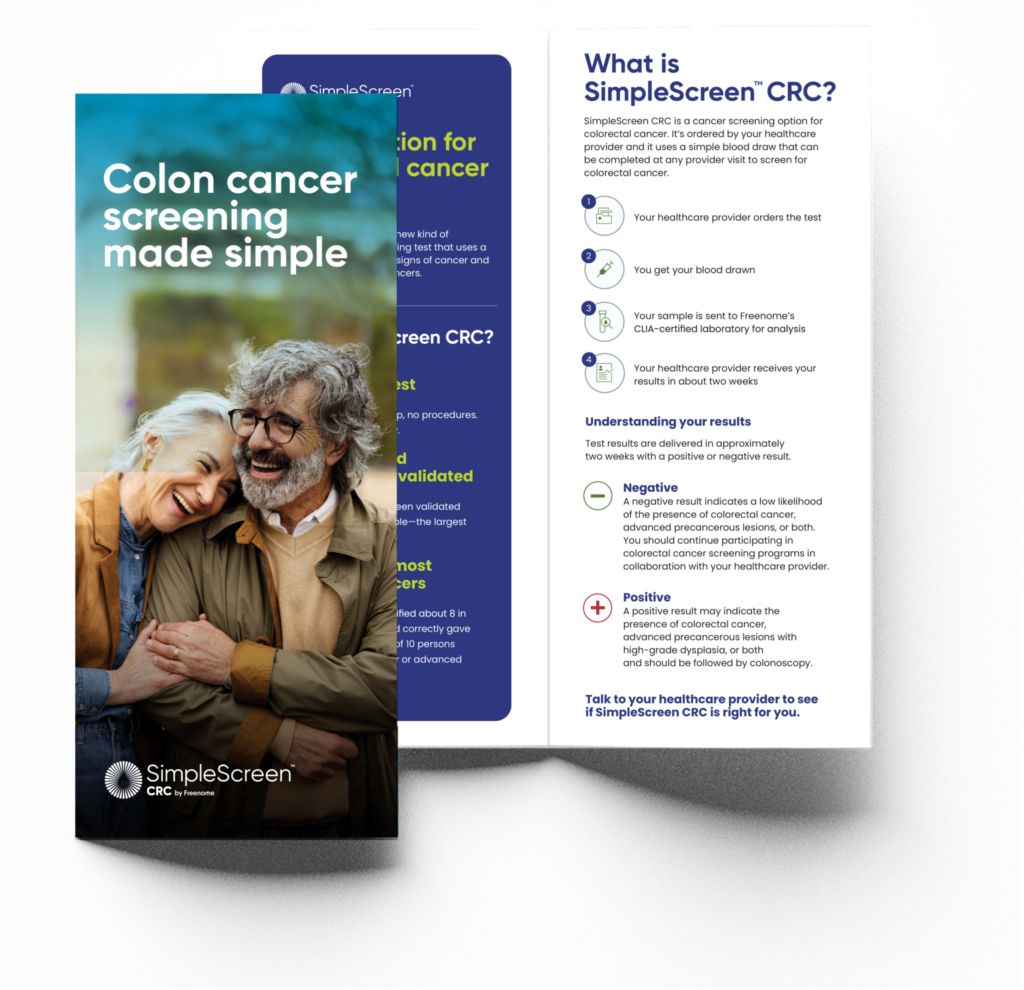
Introducing SimpleScreen™ CRC
Colon cancer screening made simple
SimpleScreen CRC by Freenome is a new kind of colorectal cancer screening test that uses a blood sample to look for signs of cancer and certain precancerous growths. No stool collection. No prep. Just a simple blood draw during your routine visit.
150,000 new colorectal cancer diagnoses annually in the U.S.
Colorectal cancer is the fourth most diagnosed cancer annually in the U.S. When colorectal cancer is found early, the five-year survival rate is greater than 90%. But after it spreads to distant organs or sites, survival drops to 13%.1
Simple blood test
No stool handling, no prep, no procedures. Just a simple blood test.
Clinically tested and rigorously validated
SimpleScreen CRC has been clinically validated in more than 27,000 people, the largest study of its kind.
Proven to find most colorectal cancers
SimpleScreen CRC correctly found about 8 in 10 colorectal cancers and correctly gave negative results for 9 of 10 people with no colorectal cancer or advanced precancers.
What is SimpleScreen CRC?
SimpleScreen CRC is a cancer screening option for colorectal cancer. It’s ordered by your healthcare provider and it uses a simple blood draw to screen for cancer.
1
Your healthcare provider orders the test
2
You get your blood drawn
3
Your sample is sent to Freenome’s CLIA-certified laboratory
4
Your healthcare provider receives your results in about 2 weeks
Understanding your results
Test results are delivered in approximately two weeks with a positive or negative result.
Negative
A negative result indicates a low likelihood of the presence of colorectal cancer, advanced precancerous lesions, or both. Healthcare providers should work with individuals to continue their recommended colorectal cancer screening.
Positive
A positive result may indicate the presence of colorectal cancer, advanced precancerous lesions with high-grade dysplasia, or both and should be followed by colonoscopy.
Talk to your healthcare provider to see if SimpleScreen CRC is right for you
Frequently asked questions
Who should screen for colorectal cancer?
Why is it important to screen for colorectal cancer?
How well does SimpleScreen CRC work?
Can anyone use SimpleScreen CRC?
It is not indicated for individuals at increased or high risk for colorectal cancer, including those with:
- A personal history of colorectal cancer, advanced precancerous lesions, or related cancers
- A family history of colorectal cancer (≥1 first-degree relatives diagnosed before the age of 60)
- Positive result on another colorectal cancer screening method within the last six months; completed a fecal occult blood test (FOBT) or a fecal immunochemical test (FIT) within the last 12 months; or completed a FIT-DNA test within the last 36 months
- Personal history of any of the following high-risk conditions for colorectal cancer:
- Hereditary non-polyposis colorectal cancer syndrome (HNPCC)
- Lynch syndrome
- Familial adenomatous polyposis (FAP)
- Inflammatory bowel disease (including Crohn’s disease or chronic ulcerative colitis)
- MUTYH-associated polyposis (MAP)
- Peutz-Jeghers syndrome, Cowden’s syndrome, or juvenile/serrated polyposis syndromes
1 Siegel RL, Kratzer TB, Giaquinto AN, Sung H, Jemal A. Cancer statistics, 2025. CA Cancer J Clin. 2025;75(1):10 45. Doi:10.3322/caac.21871
2 US Preventive Services Task Force, Davidson KW, Barry MJ, et al. Screening for colorectal cancer: US preventive services task force recommendation statement. JAMA. 2021;325(19):1965. Doi:10.1001/jama.2021.6238
3 Shaukat A, Burke CA, Chan AT, et al. Clinical validation of a circulating tumor DNA–based blood test to screen for colorectal cancer. JAMA. 2025;334(1):56-63. Doi:10.1001/jama.2025.7515
4 Data on file